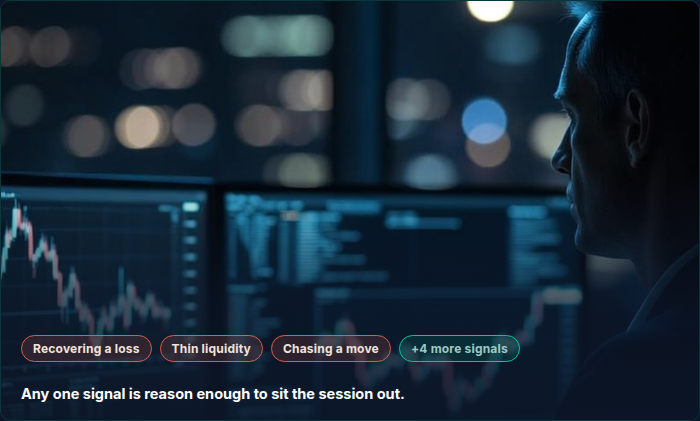
Don't trade in these seven moments: you're trying to recover a loss, a high-impact news event falls inside your session, liquidity is thin, you're chasing a move that's already happened, you don't have a setup matching your plan, you've already hit your daily loss limit or trade cap, or you're too fatigued to follow your own rules.
Discipline isn't about finding more trades, it's about correctly skipping the ones that shouldn't be taken.
- The seven moments that mean sit the session out
- Why recovering a loss makes the next trade worse, not better
- How to spot thin liquidity before it costs you in fills and slippage
- Why chasing a missed move breaks your risk-to-reward before you even enter
- What a setup that actually matches your plan looks like
- What to do the moment you hit your daily loss limit
1. You're Trying to Recover a Loss
A loss changes the size and speed of your next trade before you consciously decide anything, entries get bigger, stops get looser, setups get weaker. This is revenge trading, the single most common way a good account turns into a failed challenge.
2. A High-Impact News Event Is in Your Session
Avoid opening new trades roughly 30 minutes before and after high-impact releases like central bank rate decisions, non-farm payrolls, or CPI inflation data. Volatility spikes in both directions and normal stop placement stops working properly.
3. Liquidity Is Thin
Thin liquidity shows up as wider-than-usual spreads, price moving in short unpredictable jumps rather than a clear direction, and unusually low volume, commonly late in the Asian session or around public holidays. These conditions make stops less reliable and fills worse.
4. You're Chasing a Move That's Already Happened
Entering after a move has already run reliably produces a worse risk-to-reward than the original setup offered, the stop sits further back and the target is closer. If the entry criteria were valid five minutes ago and aren't valid now, the trade is gone, not late.
Not Sure You Can Stay Disciplined Alone?
HELYON's team helps you pass without carrying the discipline alone, pay only after you pass.
5. You Don't Have a Setup That Matches Your Plan
If a trade can't be explained in one sentence, entry, stop, target, reason, before it's opened, it isn't a setup, it's a guess. Trading without one is one of the most common ways discipline breaks down without the trader noticing.
6. You've Already Hit Your Daily Loss Limit or Trade Cap
Stop trading for the day the moment either limit is reached, full stop, see Lesson 3 for how to set that limit in the first place. It only protects the account if it's followed exactly when it's hit, not adjusted because "one more trade" feels different this time.
7. You're Too Fatigued to Follow Your Own Rules
Fatigue doesn't just slow reactions, it lowers the bar for what counts as "good enough" to take a trade. A simple test: if you wouldn't trust yourself to follow someone else's rules right now, don't trust yourself to follow your own either.
Your Pre-Session Checklist
Run these seven questions before opening a chart. Any single yes means sit this one out.
- 1
Am I trying to recover a loss?
- 2
Is high-impact news due in the next 30 minutes?
- 3
Does liquidity look thin, wide spreads, choppy price, low volume?
- 4
Am I chasing a move that's already happened?
- 5
Can I explain this setup in one sentence?
- 6
Have I hit today's loss limit or trade cap?
- 7
Am I too tired or distracted to trust my own judgement?
- Trading to recover a loss reliably makes the next trade worse
- Avoid opening trades roughly 30 minutes either side of high-impact news
- Thin liquidity makes stops less reliable even when the setup looks fine
- A missed move is gone, not late, chasing it worsens risk-to-reward
- A valid setup can be explained in one sentence before it's opened
- A daily loss limit only protects you if you stop the moment you hit it
- Fatigue lowers judgement before it slows reactions
FAQs
How close to news should I avoid trading?
Roughly 30 minutes either side of a high-impact release.
Is it ever fine to trade after a loss?
Only once it's been logged and the daily loss limit hasn't been hit, not immediately to win it back.
How do I tell thin liquidity from a normal quiet moment?
Spreads noticeably wider than usual and price jumping in small unpredictable steps rather than trending.
What if I don't have a clear reason, just a feeling?
Then there's no valid setup yet, a feeling isn't an entry, stop, target and reason.
Should the daily limit reset the next day?
Yes, provided the plan's other rules are still being followed.
Quick Knowledge Check
Pick an answer. You'll see straight away whether it's right, and why.
1. Why is trading to recover a loss risky?
2. How far from a high-impact release should you avoid opening trades?
3. What's the main risk of chasing a move that's already happened?
4. What makes something a valid setup rather than a guess?
5. What should you do the moment you hit your daily loss limit?
Skip the Costly Days, Keep the Account
HELYON offers done-for-you challenge passing, pay only after you pass.