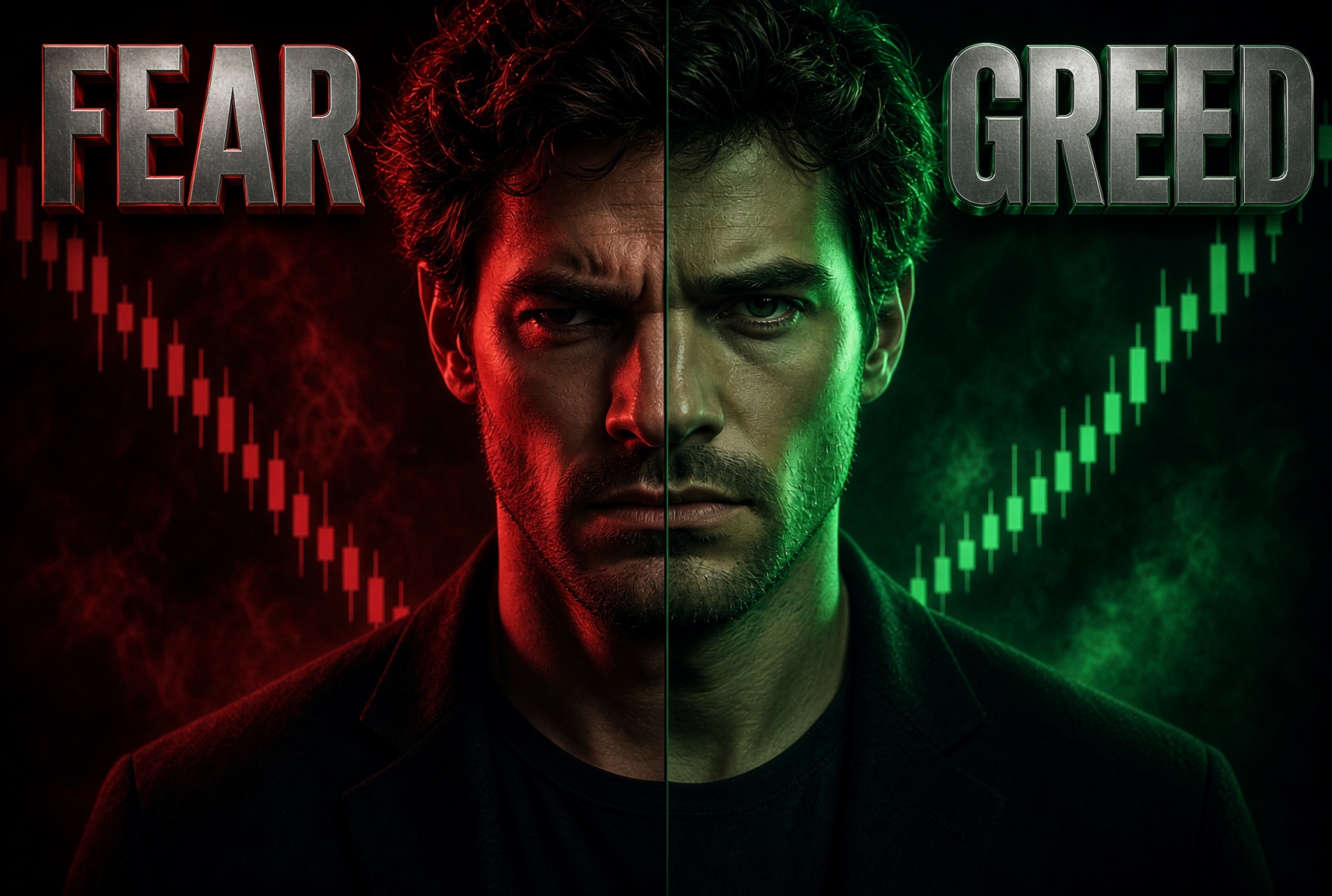
Most losing trades were never a bad idea. They were a good idea that fear talked you out of, or a plan that greed talked you past.
A trading plan only works if you follow it under pressure. Fear and greed are the two forces that talk you out of doing that.
- What separates fear-based trading from greed-based trading
- The specific behaviours each emotion causes at the moment of the trade
- How fear talks you out of a valid setup, or pulls you out of it too soon
- How greed pushes you into oversized trades, extra trades and broken rules
- Simple rules that keep your decisions objective instead of emotional
- Why a prop firm account makes both emotions more expensive
What Is the Difference Between Fear and Greed in Trading?
Fear is the emotion that makes you avoid a trade your plan already approved, and greed is the emotion that makes you take more than your plan allows. Both override a written plan, just in opposite directions.
Most trading mistakes aren't caused by a gap in market knowledge. They're caused by an emotional reaction at the exact moment of execution, and fear and greed are the two reactions that show up most often, in beginners and experienced traders alike. Professional trading doesn't mean removing emotion completely, since that isn't realistic. It means not letting emotion make the final call.
When Does Fear Take Over?
Fear usually shows up right after a loss, a drawdown, or a missed move, and it convinces you that doing nothing feels safer than following the plan you already trust.
- Skipping a setup that matches your plan, purely because the last trade lost
- Closing a trade early even though nothing about the original idea has changed
- Pulling your stop in tight because you're scared of losing again
- Cutting your position size on the fly instead of using your risk model
- Freezing at your entry point instead of pulling the trigger
When Does Greed Take Over?
Greed usually shows up after a win or a strong run, and it convinces you that the plan no longer applies because the results have earned you the right to push further.
- Sizing up after one or two winning trades
- Taking an extra trade after you've already hit the day's target
- Holding a winner past your planned exit because you want more
- Chasing a late entry because you're afraid of missing the move
- Ignoring your own drawdown limit because you feel unstoppable

How Do Fear and Greed Compare Side by Side?
The two emotions sound different in the moment but follow the same shape: a feeling stands in for the plan, and the plan loses.
| Emotion | What It Sounds Like | Common Mistake | Professional Fix |
|---|---|---|---|
| Fear | "What if this one loses too?" | Skips a valid setup | Trade only when it matches the plan |
| Fear | "I need to protect this profit" | Exits too early | Use the exit you set in advance |
| Greed | "I can squeeze out more today" | Overtrades | Stop at the daily target or trade cap |
| Greed | "This one's obvious" | Oversizes the position | Keep risk fixed per trade |
Fear avoids valid risk. Greed creates risk that was never in the plan.
Why Does This Get More Expensive Inside a Prop Firm Challenge?
A challenge adds deadlines, a daily loss limit and payout pressure on top of ordinary market risk, so the same emotional mistake that costs a personal account some money can cost a challenge account the whole pass.
The pattern shows up in familiar shapes:
- A trader one result away from finishing a phase turns cautious and lets a valid window close without taking the trade
- A trader banks a strong session, raises size the next day, and adds drawdown risk that was never in the original plan
- A trader takes one loss and goes straight back in trying to win it back before the session ends
- A trader needs one more result to hit the profit target and forces a trade that wouldn't normally qualify
How Do You Stop Fear From Running the Trade?
You control fear by deciding everything in advance, so there's nothing left to decide in the moment fear is loudest.
- 1
Define your setup before the session starts, not while price is already moving
- 2
Know your entry, stop and target before you're in the trade
- 3
Risk the same percentage on every valid setup, no exceptions
- 4
Accept the loss on the trade before you place it
- 5
Judge the trade by whether you followed the plan, not only by the outcome
How Do You Stop Greed From Running the Trade?
You control greed by setting the ceiling before a winning streak gives you a reason to ignore it, because discipline is hardest to hold onto exactly when you're winning.
- 1
Set a daily profit target and stop once you've hit it
- 2
Cap the number of trades you'll take in a session
- 3
Never raise risk because you're feeling confident
- 4
Bank or lock in profit on a schedule, not a feeling
- 5
Leave a move alone once it's already run without you
What Questions Catch Emotional Trading Before It Happens?
Five short questions before you place a trade are usually enough to reveal whether fear or greed is driving the decision instead of your plan.
- Does this trade actually match my plan?
- Am I trying to win back an earlier loss?
- Am I sizing up because I feel confident right now?
- Am I skipping this setup only because the last one lost?
- Would I still take this trade if I wasn't this close to a target?
- Fear makes you avoid a valid trade, greed makes you take more than the plan allows
- Fear tends to appear after a loss, greed tends to appear after a win
- The fix runs the same in both directions: decide everything before you're under pressure
- A prop firm challenge raises the cost of the exact same emotional mistake
- Position size is usually the first thing that moves once greed takes over
- Five honest questions before entry are usually enough to catch either emotion
FAQs
Is fear always a bad thing in trading?
No. Fear can stop you from taking reckless risk. It only becomes a problem when it stops you from following a plan you already tested and trust.
Is greed always easy to spot?
No. Greed usually feels like confidence or opportunity rather than recklessness, which is why fixed rules matter more than willpower.
Which is worse, fear or greed?
Neither. Fear costs you valid trades, greed costs you controlled risk, and a challenge account can be broken by either one.
How do I know if I'm trading on emotion rather than my plan?
If your size, entries, exits or trade frequency change with how you feel rather than what your plan says, emotion is driving the decision.
Does keeping a trading journal actually help with this?
Yes. A journal is usually the fastest way to see which emotion keeps showing up in your own trades, since the pattern is often invisible in the moment.
Quick Knowledge Check
Pick an answer. You'll see straight away whether it's right, and why.
1. What does fear typically cause a trader to do?
2. A trader wins two trades in a row and increases their next position size purely because they feel confident. What is this?
3. Which pair correctly matches a mistake to the emotion behind it?
4. Why does the same emotional mistake cost more inside a prop firm challenge than in a personal account?
5. What's the better question to ask after a losing trade?
Ready to Trade With a Plan?
Helyon offers done-for-you challenge passing, pay only after you pass.