If you've been anywhere near trading content lately, you've seen the term "prop firm challenge" everywhere, usually next to a screenshot of a payout. What most of that content skips is the part that actually matters before you pay for one: what a prop firm is, how the challenge works, and what it costs if it doesn't go to plan on the first try.
This is the guide we wish existed before we got into this space. No hype, no screenshots, just the mechanics.
A prop firm challenge is a paid, rules-based test. You're not just trading the market, you're trading the market inside a fixed set of risk limits, and those limits, not your entry fee, are what decide whether you get funded.
1. What Is a Prop Firm?
A proprietary trading firm, or "prop firm," funds traders to trade its capital instead of their own. In return, the trader agrees to trade within the firm's risk rules and shares a percentage of any profit with the firm.
Before a firm hands anyone real capital, it needs proof that person can trade profitably without blowing through its risk limits. That proof is the "challenge," sometimes called an evaluation: a demo account you trade under the firm's exact rules, for as long as it takes, to show you can hit a target without breaching the drawdown.
2. How Does a Prop Firm Challenge Work?
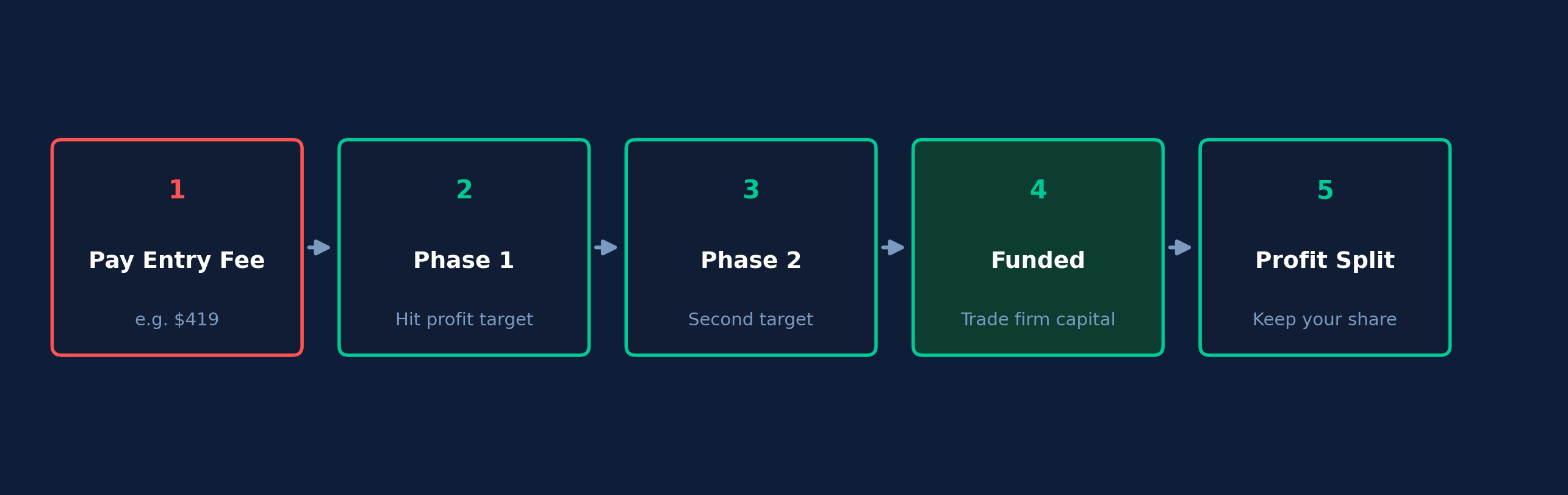
Strip away the marketing and it's a simple sequence: you pay an entry fee, trade a demo account through one or two evaluation phases, and if you hit each target without breaching the rules, the firm funds you with a real, firm-owned account. From there, you trade that capital and keep a share of what you make.
Most firms run either a single-phase ("one-step") or two-phase ("two-step") structure, which we'll get into next. The mechanics stay the same either way, only the pacing changes.
3. Why Do Prop Firms Require a Challenge at All?
It's tempting to read the challenge fee as a pure cash grab, but it's simpler than that: it's how the model gets funded. Only a fraction of people who attempt a challenge pass it, so the fees from everyone who tries fund the capital handed to everyone who does. That's not a knock on the model, it's just what it is, and it's worth understanding going in rather than being surprised by it later.
4. One-Step vs Two-Step Challenges
Both structures test the same thing, they just spread the test out differently.
One-step: a single phase with one profit target, usually set slightly higher than either phase of a two-step. Fewer hoops, faster route to funding, less room to pace yourself.
Two-step: split into two phases, typically a higher target first (commonly around 8-10%) and a lower one second (commonly around 5%). It takes longer to reach a funded account, but the lower second target gives you more margin if your first phase was a grind.
Neither is objectively better. It's a trade-off between speed and breathing room, and the right choice depends on how consistent your strategy already is.
5. Profit Target: What It Actually Means
The profit target is the percentage gain on your starting balance you need to reach, without breaching any rule, to pass a phase. On a $50,000 account with a 10% target, that's $5,000 in profit, no more complicated than that.
What trips people up isn't the math, it's forgetting that the target is only half the test. You can hit the number and still fail if you got there by breaking the drawdown rule along the way.
6. Drawdown Limit: The Rule That Ends Most Accounts
This is the rule that actually decides most outcomes, and it comes in two common forms.
Static drawdown: your maximum loss is fixed from your starting balance and never moves. Start at $50,000 with a 10% limit, and your floor is $45,000 forever, regardless of how your equity moves above that.
Trailing drawdown: the floor rises as your equity climbs, sometimes in real time, including unrealised profit on open trades. The more successful you get, the less room you have below you, which catches out traders who assume a growing balance means a growing cushion.
A profitable strategy can still fail a challenge under a trailing model, purely because the floor moved faster than expected. This is the single detail worth understanding fully before you pay for anything.
7. Account Size vs Real Risk: What Nobody Explains Upfront
A bigger account sounds like a bigger safety net. In dollar terms it is, your allowed loss is larger. In percentage terms, it isn't, the discipline required is identical no matter the account size.
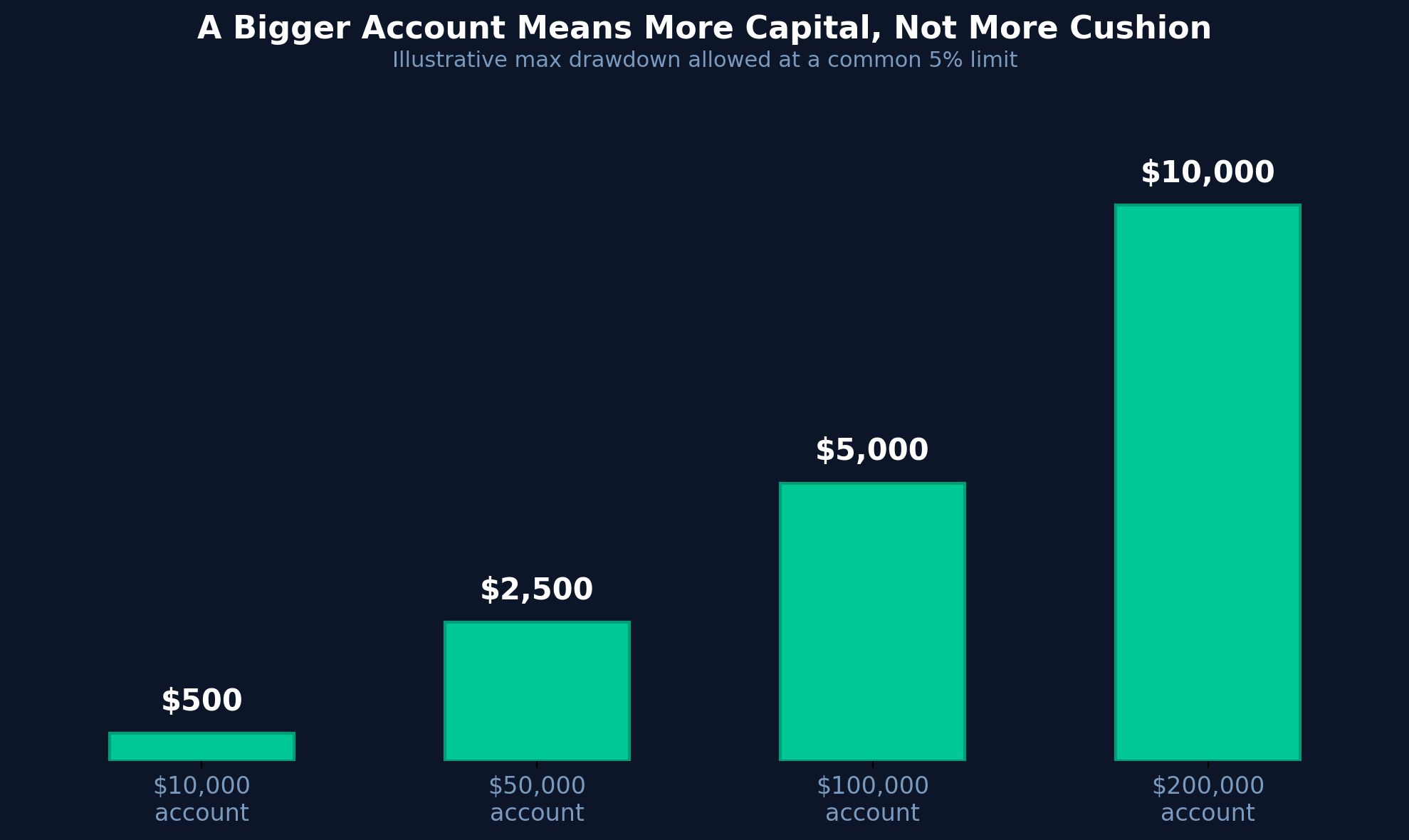
More capital means a bigger dollar cushion, not more room to be careless with it.
A $10,000 account with a 5% daily limit gives you $500 of room. A $200,000 account gives you $10,000. Traders who move up in account size without adjusting their position sizing tend to fail the bigger account faster than the smaller one, because they're used to trading in dollars rather than in percentages.
8. The Real Skill Prop Firms Test
Underneath the profit target and the drawdown limit, a challenge is measuring three things that have nothing to do with market prediction:
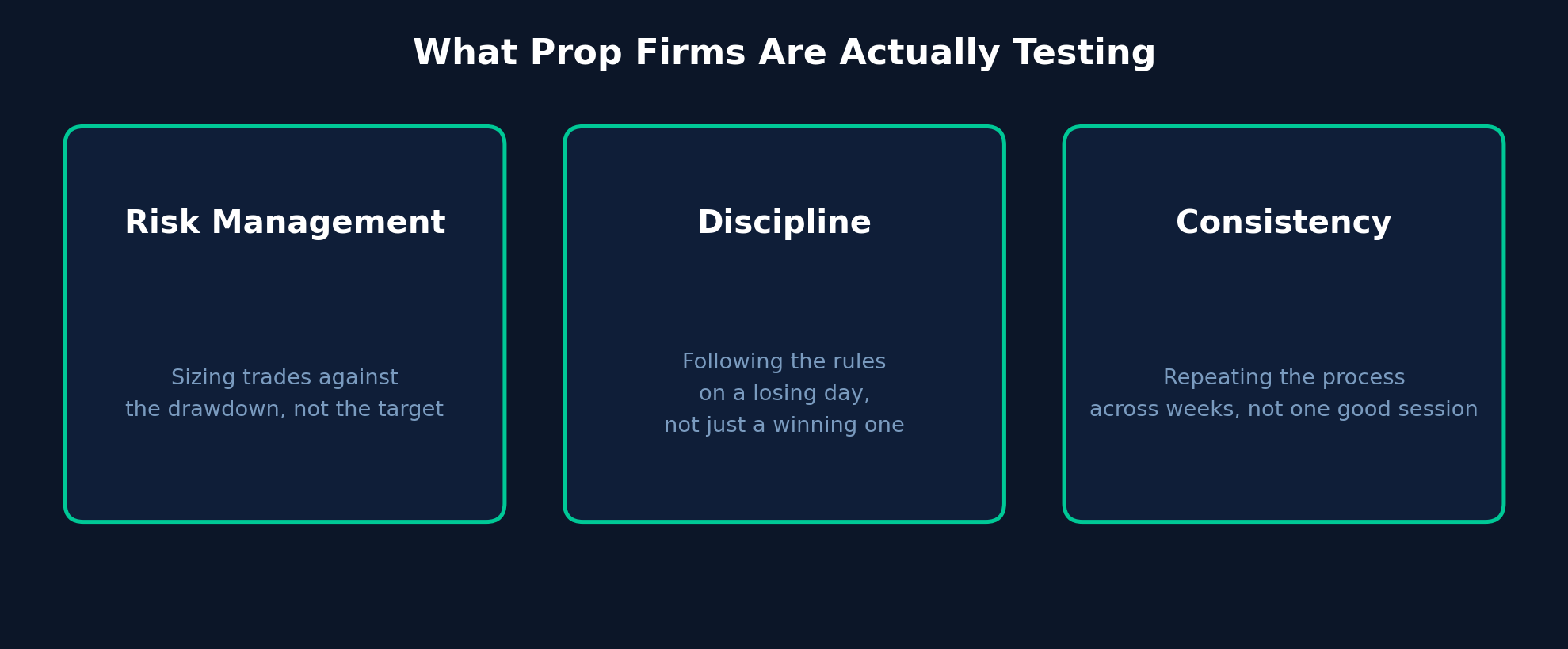
None of these show up on a chart. They show up in whether you cut a losing trade at the size you planned, whether you skip a setup that breaks your own rule just because you're bored, and whether you can do that on a Tuesday as easily as a Friday. Firms aren't testing whether you can call the market, they're testing whether you can survive being wrong without it costing you the account.
9. The Rules That Get Most Challenges Failed
Almost every failed challenge traces back to one of these, not to a bad market call:
- Sizing a position against the daily limit instead of the overall drawdown, and getting caught by the tighter of the two
- Revenge trading immediately after a loss to "make it back" before the daily reset
- Ignoring the firm's daily reset time zone and assuming a new day has started when it hasn't
- Holding through high-impact news when the firm's rules restrict it
- Checking drawdown only at the end of the day instead of tracking it in real time
10. What Happens When You Pass
Passing every phase gets you a funded account. It's still capital owned by the firm, but the profit you generate on it is real and gets paid out to you, typically on a recurring cycle such as biweekly or monthly, subject to the firm's own verification process. Profit splits vary by firm, but 70-90% is a common range, with the top end sometimes reserved for accounts that have scaled up over time.
11. What Happens When You Fail
Breaching a rule, even by a small margin, ends the challenge immediately. In most cases the entry fee is not refunded. A handful of firms offer a discounted or free retry as a goodwill gesture, but that's the exception, not something to plan around.
12. Who Should Think Twice Before Buying a Challenge
A challenge fee doesn't discriminate between someone who's ready and someone who isn't. It's worth being honest with yourself if you recognise any of these:
- You've never traded a real strategy with a fixed stop loss, only demo trades with no consequence attached
- You don't know your own average drawdown across your last 20-30 trades
- You're buying the challenge to "make back" a loss from your personal trading account
- You haven't actually read the specific firm's rulebook end to end, only a summary of it somewhere else
None of these are permanent. They're just signs the money is better spent on a demo account first than on a challenge fee.
13. Is a Prop Firm Challenge Worth It?
If you already have a tested strategy and solid risk discipline, a challenge is a genuinely efficient way to trade with more capital than your own account allows. If you're still finding your edge, the honest answer is that repeated attempts add up fast, since each failed attempt means paying the entry fee again, so it's worth knowing that going in rather than finding out the expensive way.
14. A Quick Checklist Before You Buy a Challenge
Before paying any firm, it's worth confirming these directly against their published rules:
- Is the drawdown static or trailing, and does that fit how you actually trade
- What are the exact daily and overall loss limits, in dollars, not just percentages
- Is there a consistency rule, and does it apply during the evaluation or only at payout
- What's the refund or retry policy if you fail
- What profit split do you keep on day one, not just the advertised ceiling
Want the longer version of this? Our free 8-point drawdown checklist walks through exactly what to check in any firm's rulebook before you pay.
Quick Knowledge Check
True or false: a bigger account gives you more percentage room to lose.
False. Drawdown is measured in percentage terms, so the discipline required is identical whether the account is $10,000 or $200,000. Only the dollar amount changes.
What's the main difference between a one-step and two-step challenge?
A one-step challenge has a single profit target and phase. A two-step challenge splits the evaluation into two phases, usually a higher target first and a lower one second, which spreads the pacing out but takes longer overall.
What's one sign a trader should hold off on buying a challenge?
Not knowing their own average drawdown, or buying the challenge to "make back" a loss from personal trading. Either one is a reason to spend more time on a demo account first.
What typically happens to your entry fee if you breach a rule?
In most cases it is not refunded. A small number of firms offer a discounted or free retry, but it isn't the norm.
Bottom Line
A prop firm challenge is a rules-based skills test with a real cost attached. The entry fee is the smallest number in the equation, the rules you're trading under, and how many attempts they cost you, are what actually decide the outcome. Understanding the drawdown model, the targets, and the failure points before you pay is the one piece of leverage every beginner actually has.
FAQs
What is a prop firm challenge in simple terms?
It's a paid evaluation where you trade a demo account under a firm's rules, usually a profit target and a drawdown limit, to prove you can trade profitably without breaking their risk limits. Pass, and the firm funds you with real capital to trade.
How much does a prop firm challenge typically cost?
It scales with account size. A $50,000 challenge, for example, can cost somewhere around $400, though pricing varies by firm and by which account size and challenge type you choose.
What's the difference between one-step and two-step challenges?
A one-step challenge has a single phase with one profit target to hit. A two-step challenge splits the evaluation into two phases, usually a higher target first and a lower one second, which spreads the pacing out but takes longer to reach funding.
Do I get my money back if I fail a challenge?
In most cases, no. Breaching a rule ends the challenge and the entry fee is not refunded. Some firms offer a discounted or free retry, but that is the exception rather than the norm.
Is a prop firm challenge worth it for beginners?
It depends on whether you already have a tested strategy and risk discipline before you pay. If you're still finding your edge, repeated failed attempts add up in cost quickly, so it's worth understanding the rules in detail before you buy your first one.
Not sure your first attempt should be a solo one?
See how HELYON's pass-supported service works, and what account sizes and pricing look like.
Apply Now →